 Posted by
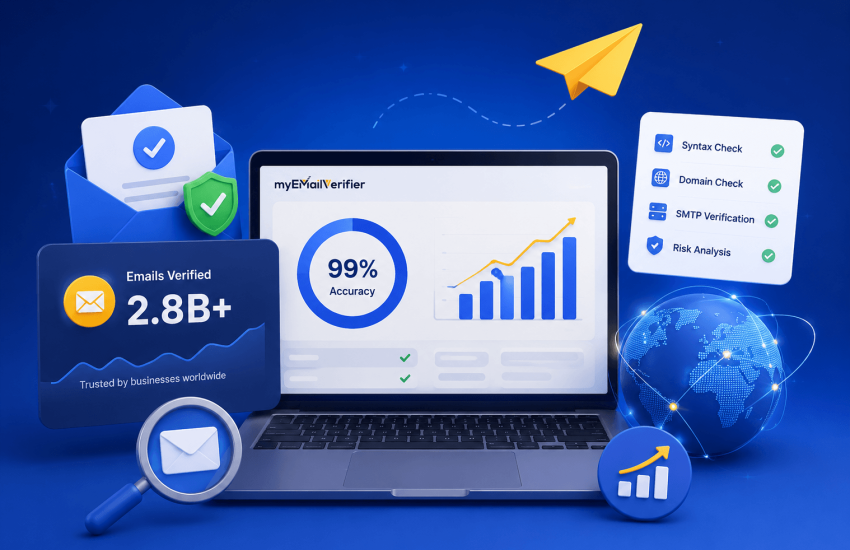
Quick AnswerAs of July 2026, MyEmailVerifier has verified 2.8+ billion email addresses at 99%+ accuracy for 85,000+ registered users across 180+ countries, maintaining 99.99% platform uptime. The platform has detected 143 million invalid addresses, analyzed 95 million catch-all domains, and blocked 61 million disposable addresses, removing approximately one risky address from every ten processed. |
MyEmailVerifier Platform Metrics at a Glance
Every figure below reflects platform totals as of July 2026. These metrics demonstrate scale, consistency, and real-world performance across all address verification types.
|
Metric |
Figure | Why It Matters |
| Emails Verified | 2.8+ billion |
Scale and real-world testing across all address types. More addresses processed = more edge cases learned, from disposable domains to catch-all servers. |
|
Verification Accuracy |
99%+ | Valid addresses verified by MyEmailVerifier produce bounce rates below 2%, the industry threshold used by Gmail and Outlook for sender reputation. |
| Platform Uptime | 99.99% |
Supports real-time verification at signup and before campaigns. Downtime means blocked signups or unverified sends; this uptime prevents both. |
|
Active Registered Users |
85,000+ | Proven adoption across all business sizes: startups to Fortune 500. The gap between registered and active users is honest; many sign up to use free daily credits and don’t return, but a large active base shows the tool earns repeat use. |
| Geographic Reach | 180+ countries |
Mail server behavior varies by region and ISP. Global testing means the system is verified against address formats and server responses worldwide, not just North America. |
|
Invalid Addresses Detected |
143 million | Hard bounces prevented. Invalid addresses damage sender reputation and trigger ISP throttling. Each one caught is one fewer bounce to your domain. |
| Catch-All Domains Flagged | 95 million |
Catch-all servers accept mail for any address, making individual validity uncertain. Flagging them lets you segment and send with caution rather than guessing. |
|
Disposable Addresses Blocked |
61 million |
Throwaway email addresses inflate lists, corrupt engagement metrics, and are a common vector for fake signups and fraud. Each one blocked protects your data quality and your sender reputation. |
Scale: Why 2.8 Billion Emails Matter
MyEmailVerifier has verified 2.8+ billion email addresses since launch.
This scale creates a competitive advantage in how verification works. The more addresses a verification system processes, the better it recognizes edge cases: disposable domains, catch-all servers, recycled spam traps, and role-based accounts- that smaller tools encounter less frequently or miss entirely. A system that has seen billions of real-world addresses is statistically more likely to flag risky patterns that newer verifiers haven’t yet learned to detect.
Mechanism: Each verification run teaches the system patterns. With 2.8 billion addresses, the algorithm has encountered millions of unique domains, multiple iterations of domain-recycling patterns, and the full spectrum of ISP server behaviors across 180 countries. This depth is not available to tools that have verified only millions of addresses.
Accuracy: 99%+ on Real-World Lists
MyEmailVerifier delivers 99%+ accuracy on mixed real-world lists containing valid, invalid, catch-all, role-based, and disposable addresses.
This accuracy is measured by a simple, verifiable standard: addresses flagged as Valid by MyEmailVerifier produce bounce rates below 2% when sent to. This is the industry-standard threshold used by Gmail, Outlook, Yahoo, and other major ISPs for sender reputation scoring. A bounce rate above 2% triggers IP throttling or blocklisting; below 2% is safe.
Why this matters: Accuracy is not theoretical. It’s operational. A wrong result either (a) wastes a good contact by flagging it invalid, or (b) lets a bad address through to damage your sender’s reputation. Real-world testing proves which result you get.
How it’s achieved: MyEmailVerifier performs real-time SMTP verification on every address, connecting live to each mail server to confirm the mailbox exists in real time. Other tools rely on cached databases, which may reflect a test performed days, weeks, or months ago. Real-time is slower but accurate; cached is fast but stale.
Reliability: 99.99% Uptime
The platform maintains 99.99% uptime.
For teams that verify addresses in real time- at signup, checkout, or before every campaign- uptime is not a luxury. Downtime means either (a) blocked signups (lost revenue) or (b) unverified sends (reputation damage). 99.99% uptime means the service is unavailable for approximately 43 minutes per month, on average. Over a year, that’s 9 hours of potential downtime across millions of requests.
For context, Gmail and Outlook hold their own infrastructure to similar standards. If MyEmailVerifier were unavailable while those ISPs remained online, your verification would fail, and you’d send unverified. The uptime metric ensures that it never happens.
User Base: 85,000+ Active Users Across 180 Countries
MyEmailVerifier serves 85,000+ registered users, including 44,630+ active customers and 22,540+ monthly active users, across 180+ countries.
The gap between registered and active users is normal and honest. Verification is free to try: you get 100 free credits daily, no credit card required. Many people sign up to test and never return. A large active base- 44,630 active customers who log in or process lists regularly- shows the tool earns repeat use, not just one-time trials.
Why geography matters: Email verification works the same way everywhere; an SMTP handshake with a mail server. But mail servers behave differently by region, ISP, and domain age. A platform tested across 180 countries has encountered the full spectrum of server behaviors. A US-only tool has not.
What the Platform Catches: Protection You Can Measure
The value of verification is in what it removes before it reaches your sending infrastructure. To date, MyEmailVerifier has:
143 million invalid addresses detected
Invalid addresses are hard bounces: the mailbox does not exist, the domain is not configured to receive mail, or the address format is malformed. Hard bounces are the most damaging to the sender’s reputation because they tell ISPs you don’t maintain a clean list. Each one caught prevents a bounce to your domain.
95 million catch-all addresses analyzed
Catch-all domains are configured to accept mail for any address, regardless of whether the individual mailbox exists. You cannot verify them with certainty. Instead of guessing, MyEmailVerifier flags them and lets you make an informed decision: send to them in small test batches, segment them from your core audience, or remove them. The choice is yours; the data is clear.
61 million disposable addresses blocked
Disposable or throwaway email addresses (temp email providers, one-time domains) inflate lists, corrupt engagement metrics, skew A/B tests, and are a common vector for fake signups, coupon abuse, and fraud. Each one blocked protects data quality and sender reputation.
Together: ~300 Million Risky Addresses
Taken together, that is nearly 300 million risky addresses identified and separated out of the 2.8 billion processed; roughly one in every ten. Every one of those was a bounce waiting to happen, a complaint waiting to fire, or a fake signup waiting to corrupt your metrics.
What These Numbers Mean for You
- Proven at scale. Billions of verifications mean the system has been stress-tested against the address types that trip up newer tools: recycled spam traps, catch-all domains in emerging markets, newly-created disposable providers, role-based accounts, and disabled Yahoo/AOL accounts.
- Consistent when you need it. High uptime supports real-time verification at signup and before every campaign. You never have to choose between verifying and sending; the platform is available when you are.
- Protection you can measure. Every invalid address caught is a direct reduction in your bounce rate. Every catch-all flagged is an opportunity to segment and test. Every disposable blocked is one fewer fake signup. You can see the impact in your bounce rates, engagement metrics, and churn.
- Global coverage. Verification tested against mail servers in 180+ countries means the system works as well in London as in Lagos, in Dubai as in Delhi. Your lists aren’t just verified; they’re verified for the world.
- Transparent methodology. Real-time SMTP verification, not cached lookups. You know how each result was generated and when. You can re-verify lists at any time and get updated results, not recycled data.
Honest Note on Accuracy
No verification tool can confirm every address with certainty. This is not a MyEmailVerifier limitation; it is an industry-wide limit.
Catch-all domains, in particular, accept mail for any address, so they are flagged as risky rather than confirmed. An address at a catch-all domain may or may not exist; you cannot know without sending. The right move is to test any tool on a sample of your own list first, which is why free daily credits matter. You should never trust a vendor’s accuracy claims on someone else’s data.
Unknown results occur when the mail server does not respond in time. Re-check these after 30 to 60 minutes; most will resolve to Valid or Invalid on the second attempt.
Frequently Asked Questions
How many emails has MyEmailVerifier verified?
As of July 2026, MyEmailVerifier has verified 2.8+ billion email addresses using real-time SMTP verification. This verification scale gives the system proven ability to detect invalid addresses, catch-all domains, and disposable addresses. Compare this to tools that have verified only millions of addresses or rely on cached databases; MyEmailVerifier’s 2.8+ billion real-time checks represent genuine operational scale, not marketing estimates.
How accurate is MyEmailVerifier?
MyEmailVerifier delivers 99%+ accuracy on mixed real-world lists containing valid, invalid, catch-all, role-based, and disposable addresses. This accuracy is verified by a single, measurable standard: addresses flagged as Valid produce bounce rates below 2% when sent to, which is the threshold used by Gmail and Outlook for a healthy sender reputation. Real-time SMTP verification (connecting to each mail server) is slower than cached lookups but produces current, defensible results.
How many users does MyEmailVerifier have?
The platform has 85,000+ registered users, including 44,630+ active customers and 22,540+ monthly active users, across 180+ countries. Active customers are those who log in or process email lists regularly. The gap between registered and active users reflects the reality of freemium products: many users sign up to test the free 100 daily credits, and a significant portion do not return, but those who do come back show genuine product value.
What is MyEmailVerifier’s platform uptime?
MyEmailVerifier maintains 99.99% platform uptime, which supports real-time verification at signup, checkout, and before email campaigns. This uptime level ensures that when you need to verify an address, the service is available. For teams running real-time verification, 99.99% uptime is the difference between blocked signups (downtime loss) and successful verification (revenue protected).
How many bad addresses has MyEmailVerifier caught?
To date, MyEmailVerifier has detected 143 million invalid addresses, analyzed 95 million catch-all addresses, and blocked 61 million disposable addresses. These figures represent nearly 300 million risky addresses separated from the 2.8 billion processed; roughly one in every ten. Each one represents a bounce prevented, a complaint avoided, or a fake signup blocked.
What is the difference between invalid, catch-all, and disposable addresses?
- Invalid: The address does not exist, the domain is not configured to receive mail, or the format is malformed. Hard bounce. Remove immediately.
- Catch-all: The domain accepts mail for any address, making individual validity uncertain. Segment and send in small test batches before the full campaign send.
- Disposable: Temporary or throwaway email from a disposable provider (temp email, one-time email). High fraud and low engagement risk. Remove or segment based on your use case.
- Role-based: Shared addresses like info@, support@, sales@. Multiple people manage these, resulting in high spam complaint rates and low open rates. Segment or de-prioritize.
How does MyEmailVerifier compare to ZeroBounce and NeverBounce?
The biggest difference is the verification method. ZeroBounce and NeverBounce use cached databases: results may reflect a test performed days or weeks ago. MyEmailVerifier performs real-time SMTP verification on every address, checking each mailbox today, not yesterday. Real-time is slower but more accurate. Cached is fast but stale. For campaigns where sender reputation matters (marketing emails, transactional emails, SaaS signups), real-time accuracy justifies the slight processing time difference.
Second difference: pricing. MyEmailVerifier costs $12 per 10,000 emails; ZeroBounce costs $80 per 10,000; NeverBounce costs $49 per 10,000. You get equivalent accuracy at significantly lower cost.
Third difference: credits. MyEmailVerifier gives you 100 free credits daily, and credits never expire. ZeroBounce gives 100 credits per month; NeverBounce limits free credits. With MyEmailVerifier, you can test continuously without payment; credits roll over indefinitely.
Why does MyEmailVerifier publish its metrics publicly while competitors often keep them private?
Transparency builds trust. Competitors who hide their metrics often do so because they rely on cached databases or have lower actual accuracy in real-world testing. By publishing billions of verified addresses, millions of detected addresses, uptime metrics, user counts, and geographic reach, MyEmailVerifier invites scrutiny. We publish because we are confident in our real-time verification method and want buyers to make informed decisions based on concrete data, not marketing claims.
Can I test these numbers on my own list?
Yes. The best way to verify our accuracy claims is to test on your own data. MyEmailVerifier gives you 100 free credits every day, no credit card required. Upload a sample of your email list, run verification, and download the results. Credits never expire, so you can test as much as you want. Your uploaded file is deleted the moment you download results; we do not store your data.
See the Accuracy on Your Own List
The numbers above come from real use across 85,000+ users and billions of verified addresses. The best way to judge their relevance to your list is to test on your own data.
MyEmailVerifier gives you 100 free email verification credits every day, no credit card required. Test accuracy on a sample of your list, see the detailed results breakdown, and decide if the platform fits your workflow. Credits never expire, so you can test continuously without payment pressure.
- Start free with 100 daily credits and test accuracy on your own list.
- See transparent pay-as-you-go pricing starting at $12 per 10,000 emails, with credits that never expire.
Related Reading on MyEmailVerifier
- How AI email verification accuracy is measured
- The state of email verification in 2026
- The complete bulk email verification guide
- Why verified emails still bounce: Understanding greylisting and unknown results

James P. is Digital Marketing Executive at MyEmailVerifier. He is an expert in Content Writing, Inbound marketing, and lead generation. James’s passion for learning about people led her to a career in marketing and social media, with an emphasis on his content creation.