 Posted by
 Spam filters can detect statistical patterns in machine-written text. But detection and penalization are different, and the evidence does not support the popular claim that AI authorship alone ends up in spam folders. What gets filtered is what bad AI email looks like: near-identical messages sent at volume from domains with no sending history to lists that were never verified. Every one of those factors predated generative AI. This article examines the circulating claims one by one and classifies each as documented, plausible, or unsupported.
Verified against available provider documentation and published analysis on 4 August 2026.
Do Spam Filters Detect AI-Written Email?
Modern filters are machine learning systems that evaluate message content, sender reputation, authentication, and recipient behavior together. They can recognize statistical patterns in text. Google, Microsoft, Yahoo, and other major providers have not publicly documented whether any particular provider treats machine-written text as a negative signal.
A filter noticing that content looks machine-generated is not the same as a filter treating machine generation as a reason to filter. The key distinction is simple: the first is technically plausible, while the second is constantly asserted and nowhere evidenced.
What Mailbox Providers Have Actually Documented
Very little that speaks directly to AI-produced content, which is itself informative. The takeaway is that providers have not documented much here at all.
Google has published work on RETVec, a text vectorizer designed to make spam classification resilient to hostile manipulation such as character substitution and homoglyph attacks. The takeaway is that this is a documented advance in text processing for spam detection. Still, it is frequently cited in AI-detection articles as though it were an AI-authorship detector. It is not; it addresses obfuscation rather than authorship.
Provider-sender requirements from Google and Yahoo, in force since 2024, specify authentication, one-click unsubscribe, and complaint-rate thresholds. None mention machine-generated content. Our coverage of Gmail bulk-sender guidelines and Microsoft Outlook authentication requirements explains what providers have actually requested.
Claim by Claim: What Circulates and What Backs It
|
Claim |
Status | Basis |
| Filters can recognize machine-written text patterns | Plausible |
Consistent with how ML classifiers work. Not documented by any provider as an active spam signal |
|
“High AI perplexity” routes email to spam |
Unsupported |
No provider documents perplexity scoring for mail. The term is borrowed from AI-detection tooling for academic text |
|
More than half of all spam is now AI-generated |
Unverifiable as stated | Widely repeated, traced to vendor analyses without published methodology. Directionally plausible, not citable as fact |
| Near-identical messages sent at volume get filtered | Documented in effect |
Bulk similarity has been a spam signal since long before generative AI |
|
Domain age and sending history dominate outcomes |
Well established | Reflected in provider sender requirements and in every deliverability practitioner account |
| Personalizing with AI improves inbox placement | Unsupported |
No evidence placement responds to personalization directly. Engagement may improve, which affects reputation over time |
|
Using ChatGPT for copy will get your domain blacklisted |
Unsupported |
No provider policy states this. Blacklisting responds to complaints, spam traps, and volume patterns |
What Actually Gets AI-Assisted Email Filtered
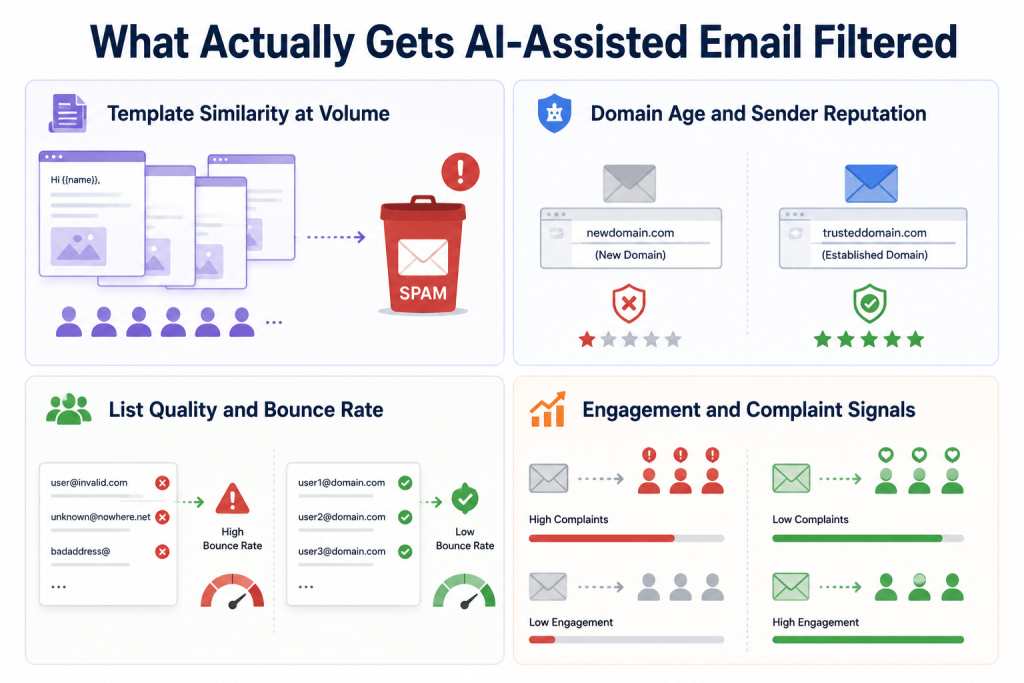
Four factors explain most filtering outcomes, and none of them is about who or what wrote the text. The practical takeaway is that the copy is usually not the main variable.
Template Similarity at Volume
Thousands of messages that differ only in a merge field are recognizable as a campaign regardless of authorship. This has been true since mail merge existed. Generative AI made producing them faster, increased volume, and made the pattern more visible to filters.
Domain Age and Sender Reputation
A new domain with no sending history has no reputation to draw on, and mailbox providers treat unknown senders conservatively. The point is that teams frequently attribute a new domain’s poor placement to their AI-written copy when the domain itself is the variable. Our guide to sender reputation score covers how reputation accumulates and degrades.
List Quality and Bounce Rate
Sending to invalid addresses generates hard bounces, and a high bounce rate is among the clearest negative signals available to a mailbox provider. Contact data decays continuously, at roughly 2.1% per month for business databases according to HubSpot’s Database Decay Simulation built on MarketingSherpa research, and ZeroBounce’s 2026 Email List Decay Report found 23% of addresses in a typical list going bad annually across more than 11 billion addresses processed.
A team that uses AI to generate outreach and send it to an unverified list will see poor results, and the list will do more damage than the copy. The takeaway is that this factor is consistently underweighted in coverage of this topic, including by us, so treat it as a hypothesis to test in your own data rather than a conclusion to accept.
Engagement and Complaint Signals
What recipients do with your mail matters more than how it was written. The practical takeaway is that complaints, deletions without reading, and lack of replies feed back into reputation. No writing technique compensates for sending to people who do not want your email.
Does the EU AI Act Change Any of This?
Not for filtering. The takeaway is that the AI Act’s Article 50 transparency obligations, which apply from 2 August 2026, place marking duties principally on providers of generative AI systems rather than on the teams using them, and its deployer disclosure duties do not extend to ordinary commercial email.
That said, if machine-readable marking becomes widespread in generative outputs, mailbox providers would in principle have a new signal available. The takeaway is that whether any provider would use it, and how, is unknown and unannounced. See our full analysis of Article 50 itself for what it actually requires for AI-generated cold email.
How to Test Your Own Email Before Sending
Testing beats theorizing, and four checks cover most of the diagnosis. The takeaway is that you can usually rule out the obvious problems before you blame the copy.
Check your authentication first, because misconfigured SPF, DKIM, or DMARC will outweigh anything about your copy. Our SPF, DKIM, and DMARC checker, along with our email authentication guide, cover the setup.
Run your message through a spam score checker to catch content-level issues. The takeaway is to verify your list before sending, since bounce rate is a stronger signal than anything in your subject line, and you can test a sample with the free bulk email verifier. Check your domain and IP against blocklists before concluding your copy is the problem.
If all four are clean and placement is still poor, then content is a reasonable next hypothesis. The point is that teams reach for it first, spending weeks rewriting copy while a DKIM misconfiguration sits unfixed.
Frequently Asked Questions
Will using ChatGPT to write my emails hurt deliverability?
There is no evidence that AI authorship by itself affects placement. The takeaway is that what affects placement is sending near-identical messages at volume from an unestablished domain to an unverified list, which is a pattern AI makes easier to produce rather than a property of AI-written text.
Can Gmail tell if AI wrote my email?
Google has not stated that it detects or scores AI authorship in mail. The takeaway is that recognizing statistical patterns in text proves technically feasible, but no provider documents using it as a spam signal.
Do AI content detectors work on email?
AI detection tools are generally unreliable with short text, and email copy is short. The takeaway is to treat any tool claiming to tell you whether a mailbox provider will flag your email as AI-written as unvalidated.
Should I stop using AI for email copy?
The evidence does not support that conclusion. The defensible position is to use AI for drafting while ensuring that messages differ meaningfully, that your domain has a sending history, that your authentication is correct, and that your list is verified.
Does personalization help with spam filters?
Personalization tends to improve engagement, and engagement, in turn, improves reputation over time, which indirectly affects placement. The takeaway is that no evidence filters directly reward personalization, and merge-field personalization on an otherwise identical template does not change the similarity pattern.
Is it true that most spam is now AI-generated?
This figure circulates widely and traces to vendor analyses without published methodology. The takeaway is that it may be directionally right, but it is not a citable fact, and we do not repeat it as one.
The Honest Conclusion
Spam filters can detect machine-written text. The takeaway is that there is no public evidence that any major provider penalizes it in this way.
What gets AI-assisted email filtered is what was filtered as bulk email before generative AI existed: sameness at volume, thin sender reputation, dirty lists, and recipients who do not want the message. The takeaway is that generative AI did not create any of those problems. It lowered the cost of producing the first one, which made the other three more visible.
The practical consequence is not a writing technique. It is authentication, domain history, list verification, and targeting. Those are unglamorous; they are the same answers that worked in 2019, and they are why the loudest advice in this space keeps failing to help.
You can address half of the list now. Every MyEmailVerifier account includes 100 free verification credits per day with no credit card required, and credits never expire. For the sending side, see our cold email verification best practices and our explanation of why verified emails still bounce, which covers the limits of what verification can promise.

James P. is Digital Marketing Executive at MyEmailVerifier. He is an expert in Content Writing, Inbound marketing, and lead generation. James’s passion for learning about people led her to a career in marketing and social media, with an emphasis on his content creation.