 Posted by
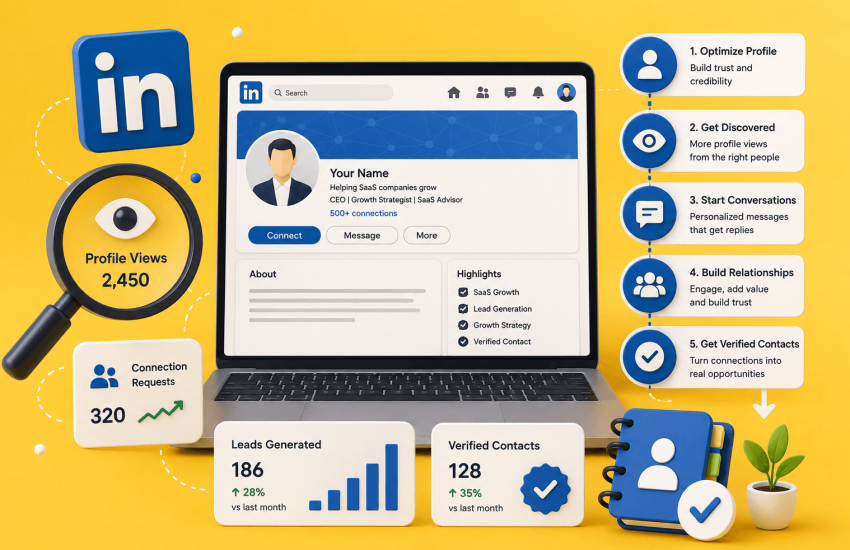
 LinkedIn lead generation is the practice of identifying, engaging, and converting professionals on LinkedIn into qualified business leads. It works because the platform combines professional intent with targeting precision no other social network offers. Most guides on this topic stop at the connection request. This one continues through the part that decides whether a LinkedIn lead becomes pipeline: moving the relationship to email with a verified address you can actually reach, so you can verify before you send and act on the contact.
What Is LinkedIn Lead Generation?
LinkedIn lead generation is the process of finding potential buyers on LinkedIn, building enough credibility or rapport to earn a response, and converting that interest into a qualified lead that your sales process can work with. It covers organic content, direct outreach, paid advertising, and the data work that connects a LinkedIn profile to a reachable contact record.
The platform’s advantage is structural. Members maintain their own professional data because their careers depend on it, which produces targeting accuracy that purchased databases cannot match at the moment of search.
Why Does LinkedIn Outperform Other B2B Channels?
LinkedIn concentrates professional buying intent in a way general social platforms do not, and the published benchmarks are consistent on this point.
According to Wpromote’s State of B2B Marketing report, cited by LinkedIn’s own marketing resources, 89% of B2B marketers use LinkedIn for lead generation, and 62% say it generates leads for them, more than twice the next highest social channel. LinkedIn also reports that cost per lead runs 28% lower than Google AdWords and that the platform ranks first for return on ad spend in B2B advertising.
One caveat worth stating, because most guides repeat it uncritically: the widely quoted claim that LinkedIn converts at three times the rate of other social platforms traces back to a HubSpot analysis published in 2016. It is old. Treat it as directional rather than current, and be skeptical of any 2026 guide presenting it as fresh data.
How Do You Set Up a Profile That Converts Visits Into Conversations?
Your profile is a landing page, and it gets visited every time you comment, post, or send a request. Three elements do most of the work.
The headline should describe who you help and what changes for them, not your job title. “Helping RevOps teams cut bounce rates below 2%” outperforms “VP of Sales” because it answers the visitor’s actual question. The About section should open with the problem you solve rather than your career history, because the first two lines are all most visitors read before deciding. The featured section should contain one specific, useful resource rather than a company brochure.
Which Organic LinkedIn Strategies Generate Inbound Leads?
Organic LinkedIn lead generation works by making the right people aware you exist before you ever contact them. Three approaches produce most of the results.
Founder and Operator Content
Personal profiles reach substantially further than company pages. Content that explains a specific decision, shows real numbers, or admits a mistake outperforms polished thought leadership because the platform’s audience is professionally sophisticated and can instantly recognize marketing copy.
Systematic Commenting
Commenting on posts your prospects already read puts you in front of them without a connection request. Substantive comments that add information get profile visits. Generic agreement gets ignored. This is the highest-return low-effort activity on the platform, and almost nobody does it consistently.
LinkedIn Events and Newsletters
Both create a recurring reason for prospects to see your name, and both produce an attendee or subscriber list you can work. Events in particular give you a legitimate reason to follow up with people who registered but did not attend.
How Do You Run LinkedIn Outreach That Gets Replies?
Effective LinkedIn outreach is specific, short, and gives the recipient a reason to care that exists independently of your product.
Connection requests with a note perform better when the note references something concrete: a post they wrote, a role change, a shared client. Requests that open with a pitch get accepted at low rates and poison the account for future attempts.
After acceptance, the most common mistake teams make is pitching immediately. The purpose of the first message is to establish relevance, not to sell. Sequences that work usually run three to four touches over two weeks, with each message adding information rather than repeating the ask.
Response rates across the platform have declined as automation volume increased. Assume the benchmark you read in a 2023 guide no longer holds, and measure your own.
The Handoff: How Do You Move a LinkedIn Lead to Email?
This is the step most LinkedIn guides skip, and it is where the pipeline actually forms: moving from LinkedIn contact to a verified email you can reach.
LinkedIn is excellent for discovery and initial contact. It is a poor system of record. Messages get buried, InMail credits run out, connection limits cap your volume, and you do not own the channel. Every serious B2B pipeline eventually migrates the relationship to email, where you control deliverability, can automate follow-up, and can integrate with your CRM.
The practical problem is that LinkedIn does not show you email addresses. Guessing a pattern from a name and company produces addresses that bounce, and bounced sends damage the sender reputation you need for everything else. That is why the handoff depends on finding a verified address, not a guessed one.
Finding a Verified Email From a LinkedIn Profile URL
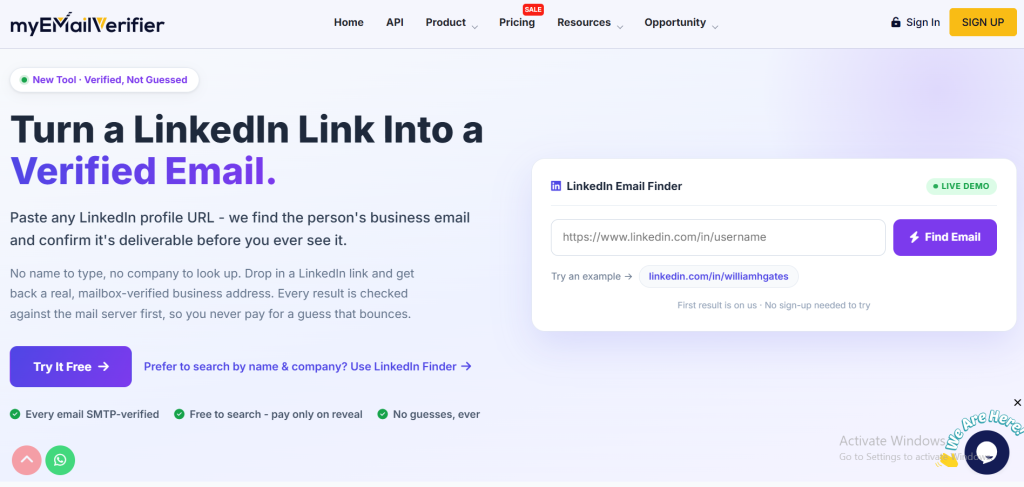
The reliable sequence is to identify the person, determine their business email, confirm the address is deliverable, and then send anything.
MyEmailVerifier’s LinkedIn email finder takes a profile URL as its only input, identifies the person and their company, calculates the business email, and confirms deliverability with the mail server before returning a result. Starting a search is free, and if no reachable address can be confirmed, the tool says so rather than returning a guess. Use it to verify before you send, because a finder that always returns something is returning fabrications, and those fabrications become your bounces.
For broader prospecting beyond a single profile, our AI lead generation tool accepts a plain-language description of your target and returns verified contacts with email and phone. If you prefer to work from a name and company rather than a URL, the free email finder handles that case.
Whichever route you use, verify before you send. Use our guides to finding anyone’s business email address and the difference between email lookup and email finder tools to understand the mechanics in more depth, and use SMTP email verification explained to confirm what a deliverability check actually confirms.
What You Should Never Do With LinkedIn Data
Scraping LinkedIn at scale violates the platform’s terms of service and risks account restriction regardless of what any tool vendor tells you. Beyond the platform rules, the legal position on contacting people you found on LinkedIn varies by market, and treating a single framework as universal creates real exposure.
United States. CAN-SPAM permits cold commercial email without prior consent, provided you identify the sender accurately, include a valid physical address, and honor opt-out requests promptly.
United Kingdom. UK GDPR requires a lawful basis for processing personal data, and PECR governs electronic marketing. Business-to-business email to corporate subscribers has more latitude than consumer email, but you still need to conduct a legitimate interest assessment and provide a clear opt-out.
United Arab Emirates. Federal data protection law requires a lawful basis for processing and gives individuals rights over their data. Consent expectations for direct marketing are generally stricter than in the US.
Saudi Arabia. The Personal Data Protection Law requires a legal basis for processing personal data and imposes restrictions on the use of direct marketing. Assume you need a documented basis rather than assuming B2B contact is exempt.
The safe operating rule across all four: contact people in a professional capacity about something plausibly relevant to their role, keep records of where the data came from, and make opting out trivial. Use our guide to email verification for GDPR compliance to handle the data side correctly.
Should You Automate LinkedIn Outreach?
Automation tools carry account restriction risk, and the vendors selling them are not well positioned to tell you that.
LinkedIn’s terms prohibit automated access, and the platform actively detects and restricts accounts running connection or messaging automation. Enforcement is inconsistent, which is why the practice persists, but the downside is asymmetric: a restricted account loses the network you spent years building, and there is no reliable appeal.
An honest assessment. Light automation of research and list building carries less risk than automation of connection requests and messaging, because the former does not produce platform-visible behavior patterns. If you automate anything, keep daily action volumes well inside human ranges and never run automation on the account that holds your primary professional network. The reason you rarely read this in LinkedIn lead generation guides is that most of them are published by companies whose product is the automation.
When Is Paid LinkedIn Lead Generation Worth It?
Paid LinkedIn makes sense when your target account list is well defined, your average contract value supports a high cost per lead, and organic reach has plateaued. If you are still deciding how LinkedIn fits alongside your other channels, our six-step system for generating leads covers channel selection, and our B2B lead generation guide ranks LinkedIn against the alternatives in terms of effort and durability.
Lead Gen Forms are the format most worth testing because they pre-populate from the member’s profile and remove the friction of a landing-page form. The tradeoff is data quality: pre-populated addresses are whatever the member entered on LinkedIn, which is frequently a personal address rather than a work one. Verify anything you collect through a Lead Gen Form before it enters a sending sequence.
For most companies with annual contract value below roughly $25,000, organic and outbound will yield better economics than LinkedIn ads. Above that, paid becomes worth the cost per lead.
Frequently Asked Questions
What is LinkedIn lead generation?
LinkedIn lead generation is the process of identifying, engaging, and converting professionals on LinkedIn into qualified business leads. It includes organic content, direct outreach, paid advertising, and the data work required to turn a profile into a reachable contact record.
Can you generate leads on LinkedIn for free?
Yes. Organic content, systematic commenting, and manual connection requests cost nothing but time and are the primary channels for most early-stage companies. Paid features like Sales Navigator improve targeting and search volume but are not required to generate leads.
How do I get someone’s email address from LinkedIn?
LinkedIn does not display email addresses, so you need a finder tool that identifies the person from their profile and determines their business email. Verify the address is deliverable before sending, because pattern-guessed addresses bounce and bounces damage your sender reputation.
Is scraping LinkedIn legal?
Scraping LinkedIn violates the platform’s terms of service and risks account restriction. The separate question of whether you can lawfully contact someone you found there depends on your market, with CAN-SPAM, UK GDPR and PECR, UAE data protection law, and Saudi PDPL each setting different requirements.
Is Sales Navigator worth the cost?
Sales Navigator is worth it when you run high enough prospecting volume that the advanced search filters and lead list management save meaningful time. For teams sending a handful of targeted messages per week, the free search is usually sufficient.
Does LinkedIn lead generation work for B2C?
Rarely. LinkedIn’s value comes from professional context and firmographic targeting, neither of which helps when your buyer is a consumer acting in a personal capacity. Consumer businesses selling to professionals are the exception.
The LinkedIn Playbook in One Page
Set up the profile as a landing page. Comment systematically on posts your prospects already read. Publish content that shows real decisions and real numbers. Send connection requests that reference something specific. Establish relevance before pitching. Then move the relationship to email with a verified address, because that is where the pipeline is actually managed.
The step that separates teams generating pipeline from teams generating connections is the handoff. If you want to test it, the LinkedIn email finder demo is free to search, and every MyEmailVerifier account includes 100 free credits daily with no credit card required.

James P. is Digital Marketing Executive at MyEmailVerifier. He is an expert in Content Writing, Inbound marketing, and lead generation. James’s passion for learning about people led her to a career in marketing and social media, with an emphasis on his content creation.