 Posted by
 SaaS lead generation is the process of attracting, qualifying, and converting prospects into product users who eventually pay. It differs from general B2B lead generation in one structural way: the product itself is the primary lead magnet, which means signup volume is easy to manufacture. Signup quality is where most teams lose money. The ten strategies below are ordered by how reliably they compound. First, it helps to define the term before moving into the differences and tactics that follow.
What Is SaaS Lead Generation?
SaaS lead generation is the set of activities a software company uses to attract potential buyers, capture their contact details, qualify their fit and intent, and move them toward a paid subscription. In subscription software, the handoff point is usually a free trial, a freemium account, or a demo request rather than a purchase. Hence, a SaaS lead is typically a product user before becoming a customer.
That distinction matters more than it sounds. In most industries, a lead is a contact record. A lead in SaaS is often an active account consuming compute, storage, support time, and onboarding email volume. A low-quality SaaS lead costs money to serve, which is not true in most other categories.
How Is SaaS Lead Generation Different From Other B2B?
SaaS lead generation differs from general B2B lead generation in four ways. Three are widely acknowledged. The fourth is where teams lose the most money, and it explains why signup quality matters so much later on. Before getting there, it helps to look at the ways SaaS departs from other B2B motions.
Longer sales cycles. Subscription commitments involve procurement, security review, and budget approval, extending decisions from weeks to months.
Buying committees rather than buyers. Multiple stakeholders evaluate the same tool from different angles, so a single champion is rarely enough to close the deal.
Narrower addressable market. A tool for revenue operations teams at mid-market companies has a market measured in thousands of accounts, not millions of consumers.
The product is the lead magnet. This is the difference nobody plans for. When your free tier is at the top of your funnel, anyone can access it, including trial abusers, bots, and people with no intention of paying. Every other B2B category has a natural filter at the point of contact. SaaS deliberately removes it, then wonders why activation metrics look strange.
Product-Led or Sales-Led: Which Motion Fits Your SaaS?
The right motion depends on your price point and how much explanation your product requires before someone sees value. Use product-led motion when the price point is lower and the product is easier to understand; use sales-led motion when the price point is higher and the product needs more explanation before value is clear.
|
Signal |
Product-led fits | Sales-led fits |
|
Annual contract value |
Under roughly $10,000 |
Above roughly $25,000 |
| Time to first value | Minutes to hours |
Days to weeks |
|
Buying committee |
One or two people | Four or more stakeholders |
| Primary lead type | Free trial or freemium signup |
Demo request or inbound inquiry |
|
Main lead gen cost |
Infrastructure and support |
Sales headcount |
Most SaaS companies in those bands run a hybrid model: self-serve for smaller accounts, sales-assisted for larger ones. Choose the motion before choosing tactics, because the same strategy produces different results under each. A free tool that generates 500 signups per month is excellent for product-led growth and close to worthless for a sales-led business selling six-figure contracts.
10 SaaS Lead Generation Strategies That Compound
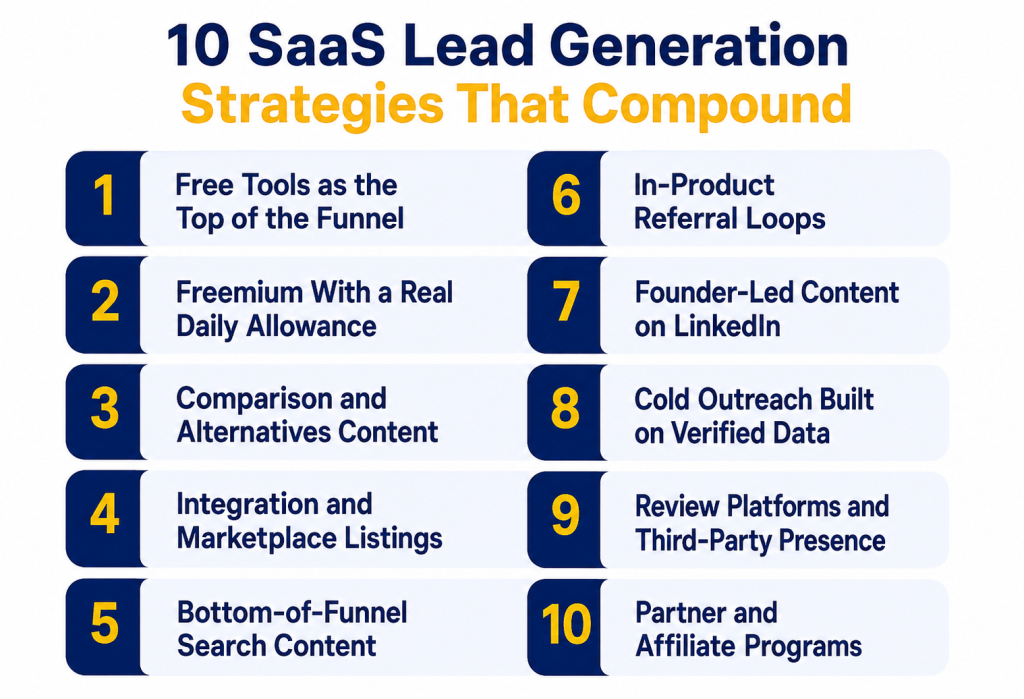
These are ordered by durability. The early entries keep producing after you stop working on them. The later ones need continuous input, so the shift from one strategy to the next reflects that difference. With that in mind, start with the tactics that compound most reliably.
1. Free Tools as the Top of the Funnel
Build small, genuinely useful tools that solve a narrow problem adjacent to your product, then give them away without requiring a signup. They rank in search, earn links, and demonstrate competence before you ask for anything.
We run this at MyEmailVerifier. Our free tools hub includes a bounce rate calculator, an SPF, DKIM, and DMARC checker, and an email list health grader, among others. An honest observation from running these free tools: they generate volume, and the traffic they attract skews toward people solving a one-time problem rather than buying software. They work as an authority and discovery layer, not as a direct pipeline source. Treat them accordingly.
2. Freemium With a Real Daily Allowance
A freemium tier that renews on a schedule gives prospects a reason to return rather than a single window to evaluate. Our own model provides 100 free verification credits every day, and credits do not expire. The recurring allowance turns a one-time trial into a habit, which is the point.
The tradeoff is real: a renewable free tier attracts abuse in a way a time-limited trial does not, which is exactly why the signup quality section below exists. That issue becomes more visible as the funnel opens up, so the next section shifts from acquisition to protection. From there, the focus turns to the risks that appear once signups start scaling.
3. Comparison and Alternatives Content
Prospects evaluating software search for your competitors by name. Pages that compare tools honestly capture searchers at the shortlist-formation stage, the highest-intent moment in the entire funnel.
This works because it meets a buyer who has already decided to buy something. We publish these ourselves, including MyEmailVerifier compared with ZeroBounce and with Hunter.io. The rule that makes them work is accuracy about the competitor. A comparison page that misrepresents a rival is discovered, and the loss of credibility outweighs the gains in traffic.
4. Integration and Marketplace Listings
Every integration you publish is a discovery surface inside someone else’s product. Users searching a marketplace for a solution are already in a workflow context, which makes their intent unusually specific.
Our integrations directory covers platforms including HubSpot, Salesforce, Zapier, and Shopify. Marketplace listings tend to produce lower volume and higher conversion than content, because the searcher has a defined problem inside a tool they already pay for. That makes them a natural bridge to bottom-of-funnel search content, where intent is even closer to action.
5. Bottom-of-Funnel Search Content
Target the queries people type when they are ready to act, rather than when they are ready to learn. “Email verification API pricing” converts at a different rate than “what is email verification,” even though the second has more volume. Our six-step system for generating leads covers how to weight your content plan across the funnel.
6. In-Product Referral Loops
Build sharing into the moments when users get value. A report worth sending to a colleague, an exportable result, or a shared workspace all carry your product into new accounts without paid acquisition.
7. Founder-Led Content on LinkedIn
Personal accounts reach further than company pages, and technical founders explaining real decisions outperform marketing copy. This works best for early-stage companies where the founder is the most credible voice available. See our guide to LinkedIn lead generation for the mechanics, and then consider outbound if you need a more direct motion.
8. Cold Outreach Built on Verified Data
Outbound works for SaaS when targeting is narrow, and data is clean. It fails when either condition breaks. Our guidance on cold email lead generation and cold email verification best practices covers the operational detail.
9. Review Platforms and Third-Party Presence
G2, Capterra, and industry communities influence shortlists you never see. They also feed the consensus signal that AI assistants use when recommending tools, which increasingly matters as buyers start their research inside ChatGPT and Perplexity rather than Google. That external influence leads naturally to partner and affiliate programs, which extend reach even further.
10. Partner and Affiliate Programs
Affiliates extend reach into audiences you have no direct relationship with. The economics only work if your retention is solid, because affiliate payouts assume a customer lifetime you have actually to deliver.
The Signup Quality Problem Nobody Talks About
Most SaaS lead generation advice ends at the signup. That is where the expensive problems begin, and the next section explains why those problems are easy to miss. To see the issue clearly, it helps to separate the main failure modes inside a signup count.
Research from Clearout on trial abuse indicates that more than half of SaaS fraud begins with fake signups, and that roughly 33% of freemium accounts use disposable email domains. Reported disposable rates vary widely by industry and offer type, with free trials and gated content attracting the highest share. The variance across published figures is wide enough that you should measure your own rate rather than assume a benchmark. With that in mind, the specific failure modes are easier to separate. The first is disposable addresses.
Four distinct problems hide inside a signup count:
- Disposable addresses. A temporary address receives the verification link, then expires. The user gets unlimited trials. You get a permanent record of a customer who never existed. We maintain a disposable email checker if you want to test your own signup data.
- Typos. A real person types gmial.com or hotmial.com. They wanted your product and never received the confirmation email. This is the most damaging category because it is pure lost revenue from a qualified prospect, and no dashboard reports it.
- Role-based addresses. info@, admin@, and support@ are shared inboxes. They are valid and receive mail, but nobody owns them, so onboarding sequences go unread, and follow-up has no individual to contact.
- Bot registrations. Automated scripts create accounts at volume for credential testing, data scraping, or resale.
The downstream cost compounds in three directions. Every automated onboarding email sent to an invalid address contributes a hard bounce against your sending domain, which means your own signup flow degrades the deliverability you need to reach real prospects. Activation and trial-to-paid conversion rates are computed against a denominator inflated with accounts that were never prospects, so the numbers you use to make decisions are wrong in a direction you cannot see. And infrastructure, support, and onboarding costs are consumed by accounts with no path to revenue. That is why the final step is blocking fake signups without adding friction.
How to Block Fake Signups Without Adding Friction
The instinct is to add verification steps. That is the wrong move, because friction at signup suppresses the real users you want alongside the ones you do not.
The better approach is to validate the address at submission, before the account is created. A real-time email verification API checks syntax, confirms the domain exists, validates MX records, performs an SMTP handshake against the mail server, and flags disposable domains, spam traps, and role-based addresses. The check runs in under a second, and the user experiences nothing unless the address fails.
For typos, the same check catches the mistake while the user is still on the page, allowing them to correct it and recover a signup that would otherwise have silently vanished. Our detailed walkthrough covers how to prevent invalid email addresses from entering your system and implement a real-time validation widget. We have also written a fuller treatment of SaaS fake signup prevention.
What verification does not solve, stated plainly. It cannot tell you whether a valid address indicates real buying intent. Someone can sign up with a legitimate work email and still be a competitor doing research, a student on a class project, or a curious engineer with no budget. Verification removes the addresses that are structurally incapable of converting. Qualifying the remaining ones is a scoring problem, not a validation problem. Catch-all domains are a second honest limitation: when a domain accepts all mail, no verification provider can confirm an individual mailbox exists, and any vendor claiming otherwise is overstating what SMTP can determine. Our deep catch-all checker improves resolution on these, but the category remains probabilistic rather than certain.
The 6 Metrics That Tell You SaaS Lead Generation Is Working
Signup count is not one of them.
- Signup-to-activation rate. The percentage of new accounts that reach a defined first-value moment. This is the earliest honest signal of lead quality.
- Trial-to-paid conversion rate. Compute it against verified signups only. Including invalid accounts in the denominator understates your real performance and hides whether changes are working.
- Onboarding email bounce rate. A rising bounce rate on transactional onboarding mail is the clearest early indicator that signup quality is degrading. Our bounce rate guidance covers thresholds and remediation.
- CAC payback period. Months of gross margin required to recover acquisition cost. This is where product-led and sales-led motions diverge sharply.
- Lead-to-opportunity rate by channel. Channel-level attribution reveals which strategies drive buyer acquisition rather than traffic.
- Net revenue retention. Lead generation that acquires poor-fit customers shows up here months later as churn.
Frequently Asked Questions
What is SaaS lead generation?
SaaS lead generation is the process of attracting potential software buyers, capturing their details, and converting them into product users who become paying subscribers. Unlike in general B2B lead generation, the entry point is usually a free trial or freemium account rather than a sales conversation, making the product itself the primary acquisition channel.
How much does SaaS lead generation cost?
Costs vary too widely by motion and market for a single benchmark to be useful. Product-led companies spend most of their acquisition budget on content, infrastructure, and support for free users. Sales-led companies spend most of theirs on headcount. The more useful measure is the CAC payback period because it accounts for both the spend and the quality of what that spend produces.
What is the best lead generation channel for an early-stage SaaS?
Bottom-of-funnel search content and founder-led social usually produce the fastest results before a company has domain authority or a sales team. Both are slow to compound and require no budget beyond time, which suits pre-revenue conditions.
How do I stop fake signups on my free trial?
Validate email addresses in real time at the point of submission rather than adding verification steps after account creation. A real-time API check flags disposable domains, invalid addresses, spam traps, and typos before the account is created, without adding friction for legitimate users.
Should I hire a SaaS lead generation agency?
Agencies are most useful when you have a proven motion and need to scale execution. They are least useful before product-market fit, when the core question is what to say rather than how loudly to say it.
Is product-led growth better than sales-led?
Neither is better in general. Product-led fits low contract values, short time-to-value, and small buying committees. Sales-led fits the inverse. Choosing based on fashion rather than contract economics is the common mistake.
Build the Engine in This Order
Before product-market fit, run only founder-led content and direct outreach. Both are cheap, both generate conversations, and conversations are what you actually need at that stage.
During early growth, add bottom-of-funnel search content and comparison pages, then implement signup verification before scaling any acquisition channel. Fixing data quality after you have scaled acquisition means cleaning up a corrupted dataset rather than preventing it.
At scale, layer in integrations, partner programs, and review platform presence. These require an existing customer base to work, which is why they belong last.
If you want to see how real-time verification affects your signup quality before committing to anything, MyEmailVerifier includes 100 free verification credits per day with no credit card required, and those credits never expire.

James P. is Digital Marketing Executive at MyEmailVerifier. He is an expert in Content Writing, Inbound marketing, and lead generation. James’s passion for learning about people led her to a career in marketing and social media, with an emphasis on his content creation.