 Posted by
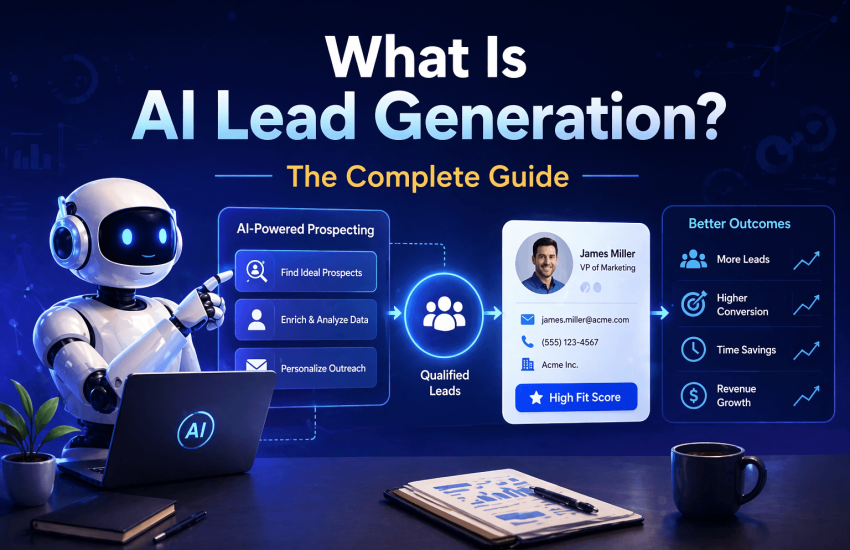
 | Quick Answer: AI lead generation is the use of artificial intelligence to automatically find, identify, and compile verified contact information for potential customers. Instead of manually searching LinkedIn or company websites, an AI system interprets a natural language description of your ideal prospect, searches multiple data sources simultaneously, and returns verified email addresses, phone numbers, and company profiles within seconds. |
Why Traditional Lead Generation Is Broken
Sales development reps spend 4.8 hours daily on manual prospecting: finding contact pages, cross-referencing LinkedIn with CRM data, testing email addresses, and rebuilding decaying lists. A marketing director prospect from last month may now be at a new company.
The issue isn’t effort. SDRs working hard, spending half their day on manual research, still rely on old methods; “one source at a time, one contact at a time”; those were created pre-AI. It’s like using a paper map instead of GPS.
AI lead generation replaces this process with a system that does in seconds what took hours. It searches multiple sources simultaneously, verifies what it finds before surfacing results, and delivers a complete, export-ready contact record rather than a partial address that still needs verification.
What Is AI Lead Generation?
| AI lead generation is the process of using artificial intelligence to automate the discovery and verification of sales prospects. The AI interprets a description of your target audience, searches the web and professional networks simultaneously, and returns verified business contact information, including email addresses, phone numbers, and company details. It eliminates the manual research phase of outbound sales. |
The keyword in that definition is verified. Early email finders scraped email addresses from the open web without verifying their validity. Many of them still do. AI-powered lead generation adds a verification layer: every address returned has passed a multi-step validation process that confirms the mailbox exists, the domain accepts mail, and the contact is not a spam trap or a disposable address.
AI lead generation tools vary in how they source and validate contacts. Some pull from static databases of pre-collected contacts, providing broad coverage but potentially outdated information. Others search the open web in real time for up-to-date contacts. Certain tools focus solely on finding email addresses, while others provide both email and phone numbers. Understanding whether a tool uses static data or performs live searches, and the kinds of contact details it can deliver, helps you select the right solution for your specific prospecting needs.
How AI Lead Generation Works: The Technical Process
The mechanics vary by platform, but most AI-powered lead generation follows a common sequence:
- Natural language input: You describe your ideal prospect in plain language. No Boolean operators, no complex filters. “CFO emails at manufacturing companies in Ohio” or “HR directors at SaaS companies with 50 to 200 employees” both work as inputs.
- Multi-source search: The AI simultaneously queries multiple data sources. Platforms like MyEmailVerifier search Google, LinkedIn, company websites, and Google Business profiles simultaneously. Static database tools (Apollo.io, ZoomInfo) query their own pre-built contact databases.
- Contact identification: The AI matches search results against your target criteria, identifies the individuals that fit your description, and extracts available contact information.
- Verification-first platforms run checks such as syntax, domain, MX records, and spam detection before showing a result, filtering out bad data early.
- Result delivery: Verified contacts are returned with full enrichment data, including company name, website, industry, location, job title, email address, and phone number where available.
- You can export contact records as CSV files compatible with HubSpot, Salesforce, Zoho, Pipedrive, and most major CRM and outreach platforms.
Real-Time Search vs. Static Database: The Crucial Difference
This distinction determines how fresh and accurate your data is.
Static database tools (Apollo.io, ZoomInfo, Snov.io) compile contact information in advance and store it in a proprietary database. When you search, you query their database, not the open web. This approach is fast, but the data ages. A contact who changed jobs six months ago may still appear with their old company and email address. The database is only as current as the last time that record was updated.
Real-time tools query the web as you search, providing fresh data, though each search takes slightly longer.
For sales teams prospecting into roles with high turnover (VP Sales, SDRs, startup founders), real-time data freshness is a meaningful advantage.
Types of AI Lead Generation Tools
The category is broad. Knowing the distinct types helps you match the right tool to your workflow.
AI Prompt-Based Lead Finders
These tools allow you to enter a natural language description of your target prospect and return matching contacts found via web and LinkedIn searches in real time. Unlike database tools, they typically do not rely on pre-stored records and instead generate results based on live data. No complex filter setup is needed, making them accessible for non-technical users. MyEmailVerifier’s AI Lead Generation is an example of this tool type. Ideal for: Sales teams that need targeted prospect lists quickly. Startups without a dedicated data operations team. Recruiters who need verified contact details for specific roles.
Database-First Prospecting Platforms
These platforms maintain large databases of business contacts and offer filters to search for records. They provide volume but less data freshness, often at a subscription cost.
Ideal for: High-volume sales teams that need consistent daily access to large contact volumes. Teams with dedicated RevOps support to manage data quality within the platform.
LinkedIn-Integrated Contact Finders
These tools connect directly to LinkedIn, either via a browser extension or an API integration, and extract verified contact details from LinkedIn profiles. Hunter.io, Lusha, and Kaspr operate in this space. They are particularly effective for targeted account-based prospecting where you start with a list of companies and need contacts within those specific organizations.
Ideal for: SDRs doing account-based outreach. Recruiters identify candidates from LinkedIn search results.
LinkedIn Export Enrichment Tools
These tools take an existing LinkedIn export (from Sales Navigator or standard LinkedIn search) and automatically enrich each record with verified email and phone numbers. They eliminate the need to run a separate search for contacts you have already identified.
Ideal for: Teams already invested in LinkedIn Sales Navigator who need contact data to activate their LinkedIn-sourced prospect lists.
Why AI Lead Generation Outperforms Manual Prospecting
AI lead generation isn’t just about cost, but primarily about output quality.
Speed
A trained SDR can research and compile approximately 25 to 40 qualified contacts per hour when working manually. An AI lead-generation tool returns the same 25 contacts in under 30 seconds. The SDR’s time is then spent on outreach, qualification, and closing, not data entry.
Data Completeness
Manual research typically produces an email address from LinkedIn or a company website, with no guarantee that it is current. AI lead generation tools that include verification and phone number lookup produce complete contact records, including a verified email address, direct-dial phone number, company name, website, industry, and location. The difference between a partial and a complete record is the difference between a prospect you can reach and one you cannot.
Accuracy
Self-verified AI lead-generation platforms report accuracy rates of 95-99% for verified email addresses. When a contact arrives with a verification pass, the probability of a hard bounce is low. Manual processes offer no equivalent guarantee of accuracy. A contact who appears valid based on a LinkedIn profile check may be using a defunct email address or have left the company.
Cost Per Contact
Manual SDR research at a fully loaded cost of $60,000 per year produces roughly 200 verified contacts per day (8 hours at 25 per hour). That works out to approximately $1.25 per contact in labor alone, not including software tools. AI lead generation at $0.0025 per verified contact (MyEmailVerifier’s rate) produces the same contact for a fraction of that cost. The SDR’s salary is then applied to activities that actually require human judgment.
What AI Lead Generation Cannot Do
A balanced understanding requires an honest assessment of limitations.
- AI can’t judge intent. It finds matching contacts but can’t confirm if they’re in-market. “Intent data” is just a guess, not proof.
- AI cannot replace relationship-based prospecting. Warm introductions, referrals, and network-based leads convert at higher rates than cold AI-sourced contacts. AI lead generation excels at top-of-funnel volume, not relationship depth.
- AI accuracy degrades for niche roles and small companies. Database tools have thinner coverage for small businesses and unusual job titles. Real-time search tools perform better in these scenarios but may still return incomplete results for very small or private companies.
- AI-generated contact lists still require the same level of outreach quality. A verified email address does not guarantee a reply. List quality is one input into outbound performance. Messaging relevance, timing, and personalization remain human responsibilities.
Who Should Use AI Lead Generation?
AI lead generation is not a single-audience tool. Different teams use it at different stages of their workflows.
Sales Teams and SDRs
Building prospect lists by job title, company type, and location is the foundational SDR activity. AI-led generation automates this step, freeing SDRs’ time for personalized outreach and follow-up. At scale, a 10-person SDR team that eliminates 4 hours of daily manual research frees up 40 hours per week for revenue-generating activities.
Marketing Agencies
Agencies that deliver lead list services to clients need a cost-effective method to produce verified, export-ready prospect files. AI lead generation on a pay-per-contact basis gives agencies per-client cost control that subscription tools do not. There is no minimum monthly spend, and credits do not expire between client engagements.
Recruiters
Recruiting is lead generation for talent. Finding hiring managers at target companies or candidates who match specific criteria requires the same multi-source search that AI-led generation provides. Direct email and phone for a recruiter are equivalent to sales email and phone for an SDR.
Founders and Startups
Early-stage companies that cannot afford enterprise sales data subscriptions ($10,000+ per year for ZoomInfo) need a cost-proportionate alternative. Tools with 100 free daily credits and no subscription requirements let founders run their own outbound from day one, without allocating a budget to data infrastructure.
Marketing Teams
Campaign targeting, account-based marketing list building, and event follow-up outreach all require verified contact data. AI lead generation provides this on demand, without the volume minimums that subscription database tools often impose.
AI Lead Generation in Practice: What a Search Actually Looks Like
Understanding the practical experience removes the abstraction from the concept.
With MyEmailVerifier’s AI Lead Generation, a search begins with a plain-language text prompt. A recruiter might type “HR managers at technology companies in Austin, Texas.” A sales rep might search “VP of Marketing at e-commerce companies in Chicago.” A founder might look for “CEOs of SaaS startups in New York with fewer than 100 employees.”
The AI interprets the prompt, queries Google, LinkedIn, company websites, and Google Business profiles simultaneously, and returns matching contact records within seconds. The output for each contact includes the full name, job title, company name, website URL, verified email address, and direct phone number where available.
You browse the results first and choose which contacts to reveal. Credits are deducted only when you reveal a contact record, not when you view search results. Revealed contacts can be re-accessed and re-downloaded at no additional charge.
The entire list can be exported to CSV with one click, ready for import into HubSpot, Salesforce, Zoho, or any outreach platform.
The Role of Email Verification in AI Lead Generation
This is where many tools diverge in real-world usefulness.
Finding an email address is not the same as confirming that the address is deliverable. A tool that returns 500 email addresses with a 30 percent bounce rate produces 150 hard bounces on your first campaign. A bounce rate above 2 percent triggers ESP review procedures. A bounce rate above 5 percent risks account suspension.
Verification-first AI lead generation tools run every email address through the following checks before delivering it:
- Syntax validation: Confirms the address follows standard email format rules.
- Domain and MX record check: Confirms the domain exists and is configured to receive email.
- SMTP handshake: Connects to the mail server and verifies that the specified mailbox exists.
- Spam trap detection: Cross-references the address against known honeypot databases.
- Greylist handling: Correctly processes temporary server rejections to avoid false invalid classifications.
- Disposable email detection: Flags throwaway addresses that will expire after use.
- Yahoo and AOL disabled user check: Identifies accounts that have been deactivated by their providers.
MyEmailVerifier applies all seven checks to every address before delivering it. The result is a 99 percent verified accuracy rate, meaning the contact you received has passed all 7 checks and is expected to receive your email.

How to Get Started with AI Lead Generation
The practical entry point is lower than most teams expect.
- Identify your target audience: Define the job title, company type, company size, industry, and geography of your ideal prospect. The more specific the description, the more relevant the results.
- Choose a tool that matches your volume and budget: If you need fewer than 100 prospects per day for initial testing, start with a tool that offers a genuine free tier. MyEmailVerifier provides 100 free daily credits with no credit card required, making it a zero-commitment starting point.
- Run a test search: Use your target audience description as a prompt. Review the returned contacts before revealing any credits to confirm the results match your criteria.
- Reveal and export: Reveal the contacts that match your criteria, download them as a CSV, and import them into your CRM or outreach platform.
- Measure against your manual baseline: Compare the time cost and accuracy of your first AI-sourced list against your previous manual prospecting output. The difference in hours recovered is the first signal of ROI.
People Also Ask: AI Lead Generation
What is the difference between AI lead generation and traditional lead generation?
Traditional lead generation requires manual research: searching LinkedIn profiles one by one, finding contact forms on company websites, and compiling spreadsheets manually. AI lead generation replaces this with automated multi-source search, real-time verification, and instant export. The primary difference is speed and accuracy: AI produces verified contacts in seconds that would take an SDR hours to compile manually.
Is AI lead generation accurate?
Accuracy depends on the tool. Verification-first platforms that run SMTP checks, spam-trap detection, and MX record validation report accuracy rates of 95-99%. Database tools without real-time verification report bounce rates of 15-25%, according to user reviews. Always confirm whether a tool verifies contacts at the mailbox level, not just the domain level.
How much does AI lead generation cost?
Cost varies widely. MyEmailVerifier charges $0.0025 per verified contact with 100 free daily credits and no subscription. Apollo.io starts at $49/user/month on paid plans. ZoomInfo starts at approximately $10,000 per year. Lusha starts at $22.45/user/month. The right choice depends on your volume, budget, and whether you need the additional features that platform tools offer beyond basic contact discovery.
Can I use AI lead generation for free?
Yes, with certain tools. MyEmailVerifier provides 100 free verification credits every day with no credit card required. This is enough to test the product and find initial prospects before committing to paid credits. Most other tools offer limited free trials (Apollo offers 100 credits/month, Lusha offers 70 credits/month), but none match MyEmailVerifier’s daily renewal of free credits without requiring a credit card.
What is the best AI lead generation tool?
The best tool depends on your use case. For affordable, pay-as-you-go access with combined email and phone output, MyEmailVerifier is the strongest option. For high-volume B2B database access with sequencing, Apollo.io or Snov.io are common choices. For enterprise-grade data with intent signals, ZoomInfo is the category leader at a significantly higher price point.
Is AI lead generation GDPR compliant?
Sourcing business contact data from publicly available sources (Google, LinkedIn, company websites) is generally compliant with GDPR as a legitimate interest use case for B2B prospecting. However, the outreach you conduct with that data must comply with GDPR requirements, including providing an opt-out and not contacting individuals who have not given implicit or explicit consent. Always verify compliance requirements with your legal team before launching any outbound campaign.
Key Takeaways
- AI lead generation is the automated discovery and verification of sales prospects using artificial intelligence to search multiple sources simultaneously.
- It outperforms manual prospecting in speed (seconds vs. hours), accuracy (95-99% vs. unverified), and cost (fractions of a cent per contact vs. $1+ per contact).
- The critical differentiator between tools is whether they verify at the mailbox level (SMTP check) or only at the domain level. Only mailbox-level verification prevents hard bounces.
- Static database tools (Apollo, ZoomInfo) offer high volume. Real-time search tools offer higher data freshness. Choosing between them depends on whether data recency or volume is your primary constraint.
- Start with a free tier to test results before committing to a paid plan. MyEmailVerifier offers 100 free daily credits with no credit card, the only genuinely free entry point in the category.
- A verified email address alone is not a guarantee of campaign success. Messaging quality, personalization, and timing remain human decisions that AI cannot replace.

James P. is Digital Marketing Executive at MyEmailVerifier. He is an expert in Content Writing, Inbound marketing, and lead generation. James’s passion for learning about people led her to a career in marketing and social media, with an emphasis on his content creation.