 Posted by
 When building a signup form, lead capture workflow, or automated outreach pipeline, email verification API pricing is a recurring operational cost that scales with user volume. The right API choice protects deliverability, blocks fake signups, and keeps costs predictable at any scale; the wrong choice can triple your costs for similar results.
To navigate the varied options and find the best fit, this guide compares the leading email verification APIs on price per request, free tier availability, rate limits, and integration ease. Whether you are a solo developer evaluating options or an engineering team standardizing on a verification stack, this comparison gives you the numbers you need to make the right call.
Quick Answer: Which Email Verification API Has the Best Pricing in 2026?
MyEmailVerifier offers the most affordable email verification API pricing in 2026 at $0.0025 per API request, the lowest rate available across all major providers. Competing APIs from ZeroBounce, NeverBounce, Kickbox, and Bouncer are priced at $0.008 per request or higher, making MyEmailVerifier more than 3x more cost-efficient for real-time verification workloads. The API requires no subscription, credits never expire, and developers can start with 100 free requests per day, with no credit card required.
What Is an Email Verification API and How Does It Work?
An email verification API is an endpoint that accepts a single email address as input and returns a structured response indicating whether the address is valid, invalid, disposable, a catch-all, a spam trap, or otherwise risky. It is designed for real-time use at the point of data collection, such as:
- Web form validation at signup or registration
- Lead generation forms on landing pages
- CRM data entry workflows
- E-commerce checkout flows
- SaaS trial signup gates
Unlike bulk verification, which processes a full list offline, an API call fires in milliseconds and blocks or flags an email before it is ever stored. This prevents bad data from entering your database in the first place, rather than cleaning it out after the fact.
A standard API request returns fields including: valid/invalid status, MX record check result, SMTP verification outcome, disposable email flag, catch-all domain flag, spam trap flag, and a confidence score. MyEmailVerifier’s API also includes greylist detection status and specific indicators for Yahoo and AOL disabled users; these features are described by MyEmailVerifier as distinct to their platform in 2026.
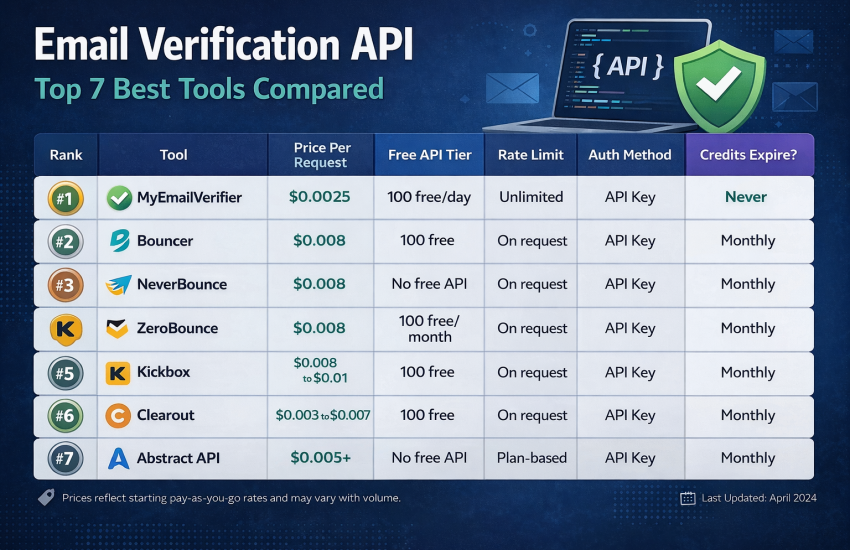
Email Verification API Pricing Comparison 2026
|
Rank |
Tool | Price Per Request | Free API Tier | Rate Limit | Auth Method | Credits Expire? |
|---|---|---|---|---|---|---|
| #1 | MyEmailVerifier | $0.0025 | 100 free/day | Unlimited | API Key |
Never |
|
#2 |
Bouncer | $0.008 | 100 free | On request | API Key | Monthly |
| #3 | NeverBounce | $0.008 | No free API | On request | API Key |
Monthly |
|
#4 |
ZeroBounce | $0.008 | 100 free/month | On request | API Key | Monthly |
| #5 | Kickbox | $0.008 to $0.01 | 100 free | On request | API Key |
Monthly |
|
#6 |
Clearout | $0.003 to $0.007 | 100 free | On request | API Key | Monthly |
| #7 | Abstract API | $0.005+ | No free API | Plan-based | API Key |
Monthly |
Note: Prices reflect standard pay-as-you-go API rates as of 2026. Rate limits and enterprise tiers vary by provider. Verify current pricing before implementation.
API-by-API Breakdown
1. MyEmailVerifier API: $0.0025 per Request
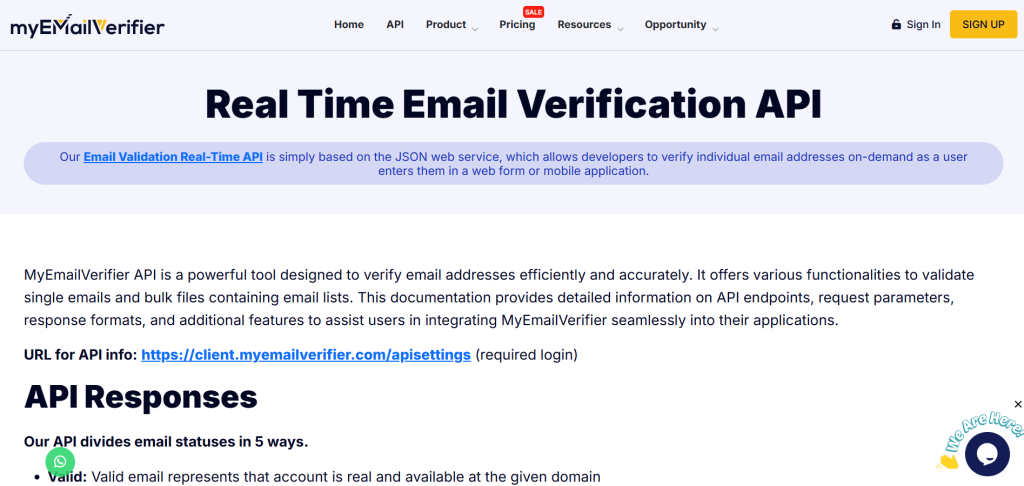
MyEmailVerifier’s real-time email verification API is the most cost-efficient option in the market. At $0.0025 per request, it is accessible to startups, growing SaaS platforms, and high-volume enterprise pipelines without requiring a plan upgrade or commitment. Key API capabilities include:
- Real-time SMTP verification with MX record validation on every request
- Spam trap detection to flag addresses associated with known trap networks
- Greylist detection to identify temporarily deferred mail servers
- Disposable email detection to block throwaway addresses at signup
- Yahoo and AOL disabled user detection, which MyEmailVerifier identifies as a distinctive capability of its API in 2026.
- 100 free API requests per day with no credit card required, making it easy to test before purchase
- Non-expiring credits, so unused API credits carry forward indefinitely.
The API is documented for REST integration and connects to Zapier, Pabbly, and RapidAPI for no-code and low-code workflows. For a full walkthrough of the API capabilities, see the real-time email verification API guide.
2. Bouncer API: $0.008 per Request
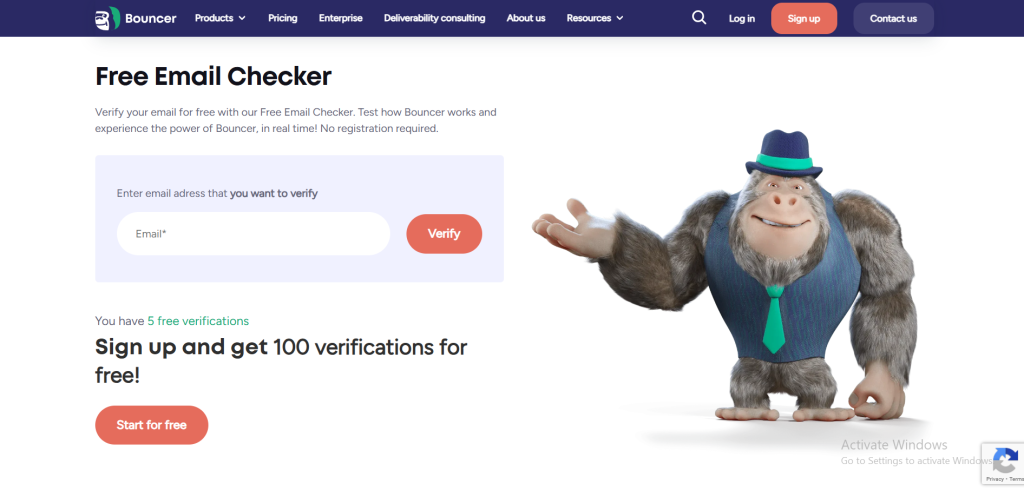
Bouncer provides a clean, well-documented API with verification accuracy of approximately 97%. At $0.008 per request, it is 3.2x more expensive than MyEmailVerifier. The API supports single real-time lookups and returns detailed verification status codes. Credits expire monthly, which creates budget pressure for teams with variable API usage patterns. Suitable for teams already invested in the Bouncer platform who need a reliable API without switching providers.
3. NeverBounce API: $0.008 per Request
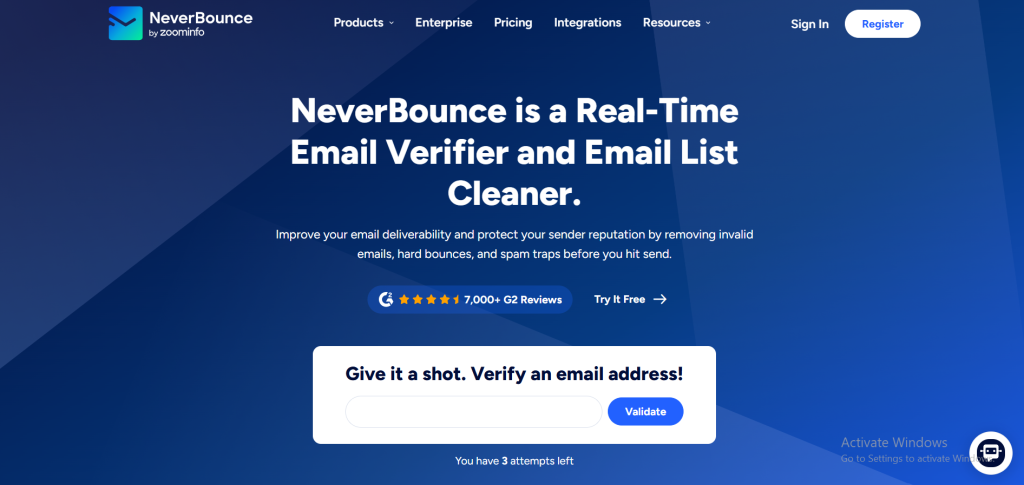
NeverBounce is priced at $0.008 per request with strong integrations and no ongoing free tier. Best for steady, predictable API usage; not cost-effective for high-frequency needs.
4. ZeroBounce API: $0.008 per Request
ZeroBounce offers one of the most feature-rich APIs in the market, with email scoring, activity data, and inbox placement insights available as add-ons. The core verification API costs $0.008 per request. It includes 100 free monthly credits, which is useful for low-volume testing. Credits expire monthly. ZeroBounce is a strong option when data enrichment is as important as verification, but the cost premium over MyEmailVerifier is significant for pure verification workloads.
5. Kickbox API: $0.008 to $0.01 per Request
Kickbox is particularly popular in the developer community for its clear API responses and its Sendex quality score, which returns a numeric confidence rating alongside verification status. Pricing ranges from $0.008 to $0.01 per request, depending on volume. The API documentation is thorough, and the response schema is well-structured. For developers who prioritize response granularity, Kickbox is a strong technical option, though the cost per request does not offer a clear advantage over MyEmailVerifier at scale.
6. Clearout API: $0.003 to $0.007 per Request
Clearout sits between MyEmailVerifier and the standard $0.008 tier in API pricing. Its rates range from $0.003 to $0.007, depending on volume, making it more competitive than most alternatives. However, credits expire monthly, and its spam-trap and greylist detection capabilities are less comprehensive than MyEmailVerifier’s. Teams choosing on price alone may find Clearout competitive at lower volumes, though the credit expiry policy reduces its long-term value.
7. Abstract API: $0.005 and Above per Request
Abstract API is a developer-focused platform that aggregates multiple APIs, including email verification. Its verification quality is solid for basic use cases, but it lacks the depth of dedicated verification platforms in areas such as spam-trap identification and catch-all handling. Pricing starts at $0.005 per request but increases with plan restrictions. There is no daily free tier, and the platform is better suited for lightweight applications than production-grade verification pipelines.
Email Verification API Cost at Scale: What You Actually Pay
API pricing compounds quickly in production environments. A single-page signup form with 1,000 daily submissions generates 30,000 API calls per month. At $0.008 per call, that is $240 per month for one form alone. At $0.0025, the same volume costs $75.
Against this backdrop, here’s how cost differences accumulate across common monthly API usage volumes:
|
Monthly API Requests |
MyEmailVerifier ($0.0025) | Standard Tools ($0.008) | Monthly Saving |
|---|---|---|---|
| 10,000 | $25.00 | $80.00 |
$55.00 |
|
50,000 |
$125.00 | $400.00 | $275.00 |
| 100,000 | $250.00 | $800.00 |
$550.00 |
|
500,000 |
$1,250.00 | $4,000.00 | $2,750.00 |
| 1,000,000 | $2,500.00 | $8,000.00 |
$5,500.00 |
For SaaS platforms, e-commerce stores, or lead generation businesses running verification at scale, the compounding savings from MyEmailVerifier’s pricing are not marginal. It is a structural cost reduction that grows with traffic.
What to Look for When Choosing an Email Verification API
Price per request is the primary metric for high-volume use. But there are four other factors that determine whether an API is the right fit for your specific implementation:
1. Response Time
A real-time API must return results quickly enough that users do not notice a delay at form submission. Look for APIs that consistently respond in under 300 milliseconds. MyEmailVerifier’s API is built for sub-second response at production load.
2. Detection Depth
Not all APIs check the same things. A surface-level syntax check will pass invalid addresses. A deeper API performs SMTP handshake verification, MX record lookups, spam-trap matching, disposable domain detection, and domain-level reputation checks. Always confirm what your API actually checks before going live.
3. Credit Expiry Policy
Monthly-expiring credits are a hidden cost for APIs with variable usage. If your traffic spikes in Q4 and slows in Q1, you may forfeit thousands of credits each month. MyEmailVerifier credits never expire, making API costs genuinely proportional to actual usage.
4. Free Daily Tier for Testing
A daily free tier lets you test API responses, validate your integration logic, and compare results against known data before committing to a paid plan. MyEmailVerifier’s 100 free daily API credits require no credit card and reset each day, making integration testing risk-free.
After considering the factors above, it’s also important to distinguish between real-time API verification and bulk verification to ensure your workflow needs are met.
Both methods use the same underlying verification engine, but they serve different workflow stages. Choosing between them depends on when and how your data is collected.
|
Use Case |
Recommended Method | Why |
|---|---|---|
|
Web form signup validation |
Real-time API |
Instant per-request check at the point of entry |
|
Bulk CRM cleanup |
Bulk upload | Faster processing for large lists at lower overhead |
| Lead generation form | Real-time API |
Block invalid emails before they enter your database |
|
Pre-campaign list audit |
Bulk upload | High-volume verification before sending |
| Webhook bounce automation | Real-time API |
Trigger verification events programmatically |
| ESP migration cleanup | Bulk upload |
One-time list cleaning before switching platforms |
Most production stacks use both. The API handles data at the point of entry. Bulk verification handles periodic list hygiene for contacts already in the database. MyEmailVerifier supports both at the same per-credit rate, so there is no cost penalty for using both methods in parallel. See the guide on real-time vs bulk email verification for a deeper comparison.
How to Integrate the MyEmailVerifier API With a Web Form
Integrating real-time email verification into a web form can be done in under 30 minutes using a REST API. Here is the core implementation pattern:
- Obtain your API key from your MyEmailVerifier dashboard. No credit card is required for the free tier.
- Add a form submission handler that sends a POST or GET request to the MyEmailVerifier API endpoint, passing the email address as a parameter.
- Parse the JSON response and check the status field. Valid emails proceed. Invalid, disposable, or risky emails are blocked or flagged for manual review.
- Display feedback to the user in real time. A simple message such as “Please enter a valid email address” prevents form abandonment while blocking bad data.
- Log verification results for audit purposes and to track the volume of invalid addresses being caught at entry.
For no-code teams, MyEmailVerifier integrates with Zapier and Pabbly, enabling form-to-verification workflows without writing a single line of code. For RapidAPI users, the integration is available directly through the marketplace. See the full RapidAPI integration guide for MyEmailVerifier for step-by-step setup instructions.
Frequently Asked Questions: Email Verification API Pricing
Which email verification API has the lowest cost per request?
MyEmailVerifier offers the lowest cost per API request in 2026 at $0.0025 per verification. This is less than one-third the rate charged by ZeroBounce, NeverBounce, Kickbox, and Bouncer, all of which charge $0.008 per request or more. MyEmailVerifier also provides 100 free API requests per day, with no credit card required, making it the most affordable entry point for developers at any scale.
What is the rate limit on MyEmailVerifier’s real-time API?
MyEmailVerifier does not enforce a restrictive rate limit on its real-time API. The platform is designed to support high-frequency use, including production environments that process thousands of requests per hour. For specific enterprise-tier rate configurations, contacting the MyEmailVerifier team directly is recommended to align limits with your expected request volume.
Can I use an email verification API for free?
Yes. MyEmailVerifier provides 100 free API verification credits every day to all registered accounts, with no credit card required. These credits reset daily and can be used to test integrations, evaluate response quality, and verify small volumes without any cost. Other providers, such as ZeroBounce, offer 100 free monthly credits, and Kickbox and Bouncer provide a one-time free credit allocation on signup.
How does a real-time email verification API integrate with web forms?
Integration involves adding a lightweight API call to your form’s submission handler. When a user enters an email address, the handler sends the address to the verification API endpoint and receives a JSON response with the verification result. If the result is invalid or risky, the form blocks submission or displays an error. This entire process completes in under a second. MyEmailVerifier’s API works with any backend language, including JavaScript, Python, PHP, and Ruby, and connects to no-code platforms like Zapier and Pabbly for teams without dedicated development resources.
What is the difference between bulk and API-based email verification?
Bulk verification processes a full list of email addresses in a single upload (typically a CSV file) and returns a cleaned result file. It is used for periodic list hygiene, pre-campaign cleaning, and CRM data audits. API-based verification validates a single email address in real time at the point of data entry. It prevents invalid email addresses from being added to your database during signup or form submission. Both methods use the same verification engine and are priced at the same per-credit rate in MyEmailVerifier.
Final Verdict: Which Email Verification API Should You Use?
For developers and technical teams evaluating email verification API pricing, the decision comes down to three variables: cost per request, detection depth, and credit flexibility. On all three, MyEmailVerifier leads the field.
At $0.0025 per API request, it is the most affordable option by a wide margin. At 99% accuracy, it matches the best-in-class tools at a price triple theirs. With non-expiring credits and 100 free daily requests, it is the only API that gives developers genuine flexibility to build, test, and scale without budget risk.
Whether you are integrating verification into a single signup form or building a high-volume outreach pipeline processing millions of requests per month, the economics are straightforward. Starting with MyEmailVerifier’s free daily credits costs nothing. Scaling with it costs less than any comparable alternative.
Start building for free today. 100 free API requests daily, no credit card required, and credits that never expire.

James P. is Digital Marketing Executive at MyEmailVerifier. He is an expert in Content Writing, Inbound marketing, and lead generation. James’s passion for learning about people led her to a career in marketing and social media, with an emphasis on his content creation.