 Posted by
 Your Email List Is Quietly Decaying
No email list stays clean on its own. People change jobs. Companies shut down domains. Subscribers sign up with temporary emails. Contacts abandon accounts. Over time, a percentage of lists become invalid.
The challenge is that list decay is invisible until it causes damage. You do not know how many addresses are bad until bounce rates spike, sender scores drop, or an email service provider suspends your account. By then, the problem had already affected multiple campaigns.
An email list cleaning service acts before decay escalates. Take action: review your current list-cleaning process, identify any recent list-performance issues, and schedule a cleaning cycle before your next major campaign. This guide explains what the service does, when your business needs it, what to look for when choosing a provider, and the mistakes that cost senders the most.
| Quick Definition: An email list cleaning service, also called an email list scrubbing service or email hygiene service, is a tool or platform that validates email addresses in your contact database and identifies which ones are safe to send to, which are risky, and which should be removed. |
What Is an Email List Cleaning Service?
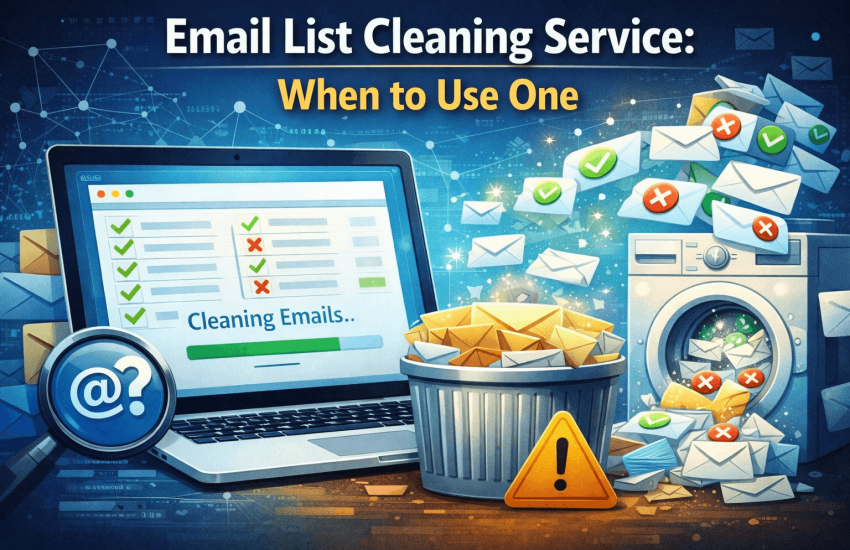
An email list cleaning service runs each address in your list through a series of technical checks to determine whether it is valid and deliverable. These checks happen without actually sending an email.
Core Verification Checks
- Syntax validation: Finds badly formatted email addresses.
- Domain and MX record lookup: Confirms that the domain can receive email.
- SMTP verification: Checks if the mailbox exists on the email server.
- Catch-all detection: Spots domains accepting all email, valid or not.
- Disposable email detection: Flags temporary single-use email addresses.
- Spam trap identification: Detects honeypot addresses used to expose poor list hygiene.
- Role-based address detection: Identifies addresses such as info@, support@, admin@, and sales@ that route to shared inboxes rather than to individual recipients.
- Greylist handling: delays domain verification to avoid false results.
The result is a categorized list that tells you exactly what to do with each address rather than a simple pass/fail output.
Why Email List Hygiene Matters: The Business Case
List hygiene is a critical business process with direct financial and operational impacts for all email senders.
Bounce Rate
Hard bounces occur when an email is sent to an invalid address. Most email service providers set hard bounce thresholds between 2% and 5%. Exceeding this threshold triggers automatic account reviews and may result in the suspension or permanent revocation of sending privileges.
Read: How Email Bounce Rates Affect Your Email Marketing ROI
Sender Reputation
Mailbox providers like Google, Microsoft, and Yahoo assign a reputation score to every sending domain and IP address. This score influences inbox placement for every future campaign. Repeated bounces, spam complaints, and sends to spam trap addresses lower the score. A damaged sender reputation does not recover quickly. It takes consistent, clean sending over weeks or months to rebuild trust with inbox providers.
Campaign ROI
If 15% of your list is invalid, you are paying to send 15% of every campaign to addresses that will never receive it. The wasted sending cost is the visible problem. The less visible problem is the diluted analytics. Open and click rates calculated against a bloated invalid list underestimate true engagement, skewing decisions about content, frequency, and segmentation.
Read: How Email Bounce Rates Affect Your Email Marketing ROI
List Decay Rate
Email addresses become invalid at an estimated rate of 22 to 28 percent per year. A 50,000-contact list built a year ago may now contain 11,000 to 14,000 invalid or undeliverable addresses. This reflects the documented reality of contact database decay across industries.
| The cost of ignoring list hygiene is not just wasted budget. It is compounded reputation damage, reduced inbox placement, and suppressed engagement metrics across all future campaigns. |
When Does a Business Actually Need an Email List Cleaning Service?
Not every situation requires immediate action, but certain trigger points make cleaning urgent.
Trigger 1: Before Any Major Campaign
If you plan to send to a list of 10,000 or more contacts, verify before sending. The likelihood of invalidity rises with list size and age. Pre-campaign cleaning addresses problems before they affect deliverability.
Trigger 2: After a Long Period of Inactivity
A list that has not been mailed in the past 6 months or more will show significant decay. Contacts who changed jobs, abandoned accounts, or let domains expire are no longer reachable. Sending to a stale list without cleaning is a fast way to cause a high bounce rate, even if the list appeared healthy.
Trigger 3: After Importing External or Purchased Data
Purchased lists, imported partner data, and scraped contact databases carry a higher proportion of invalid, role-based, and trap addresses than organically collected lists. Every external data source should be verified before being added to your primary send list.
Trigger 4: After Bounce Rate Exceeds 2%
If a campaign has already returned a bounce rate above 2%, cleaning the remaining list before the next send is necessary to prevent further damage to the sender’s reputation. Do not wait for a second high-bounce campaign.
Trigger 5: When Onboarding to a New ESP
Email service providers closely monitor the reputation of new accounts during the early sending period. High bounce rates in the first few campaigns can result in immediate account restriction. Cleaning your list before migrating to a new platform helps ensure the new account doesn’t inherit existing list quality issues.
Trigger 6: As Part of a Quarterly Hygiene Schedule
For businesses with active lists of 25,000+ contacts, a quarterly verification schedule prevents invalidity from accumulating over time. It is less expensive to run scheduled maintenance than to recover from a deliverability crisis.
What to Look For in an Email List Cleaning Service
The market has dozens of providers. These are the criteria that separate effective services from those that sound capable but underdeliver at scale.
1. Verification Accuracy
The most important metric. Accuracy describes the percentage of addresses that are correctly classified. A low-accuracy tool has two failure modes: marking valid addresses as invalid (you lose legitimate reach) and marking invalid addresses as valid (you send to bad contacts and generate bounces). Target services that document 97% or higher accuracy.
2. Verification Depth
Basic tools stop at syntax and domain checks. These miss the problems that actually cause damage to deliverability. An effective service runs at a minimum: syntax check, MX record lookup, SMTP verification, catch-all detection, disposable email detection, spam trap identification, and role-based address detection.
3. Processing Speed
Speed matters for time-sensitive campaigns. A service that takes 24 hours to verify 50,000 emails is a bottleneck. For most professional services, 100,000 emails should be completed in under 2 hours.
4. Pricing Model
Two primary models exist: subscription (monthly volume allocation) and pay-as-you-go (credits per email). Pay-as-you-go is more flexible for businesses with variable volume. The critical variable is whether credits expire. Non-expiring credits let you purchase volume when pricing is favorable, without the pressure of using them before they expire.
5. Result Output Quality
A useful result file categorizes each address by status and sub-status. Binary valid/invalid output is not sufficient. You need to know whether an address is a disposable email, a spam trap, a catch-all domain, or a role-based address to make the right decision for each.
6. Integration Options
Standalone bulk upload works for periodic cleaning. Real-time API integration is necessary for teams that need to validate emails at the point of entry. A service with both options covers all use cases without requiring separate tools for batch and real-time validation.
7. Data Security and Compliance
Your contact list contains personally identifiable information. The cleaning service must process data securely, not store it after delivery, and comply with GDPR requirements if your contacts include EU residents.
How to Choose: A Decision Framework
Best choice depends on your primary use case:
|
Mistakes That Undermine Email List Cleaning
Cleaning Once and Never Again
Email verification is not a one-time fix. It is ongoing maintenance. A list cleaned today will be 5-7% invalid within 3 months due to natural decay. Treat cleaning as a process, not a project.
Sending to All Catch-All Addresses
A catch-all domain accepts all incoming mail at the server level, including messages sent to non-existent mailboxes. Tools that mark all catch-all addresses as “valid” are technically correct at the server level but wrong about actual deliverability. Sending a full campaign to catch-all addresses without any filtering or test sends generates bounces that damage the sender’s reputation.
Using a Free Tool for Large Lists
Free email verification tools process small volumes with limited check depth. At scale, they miss spam traps, do not handle greylisting, and provide minimal categorization. For lists with more than 5,000 contacts, use a professional service with documented accuracy rates and full verification depth.
Ignoring Unknown Status Addresses
Unknown addresses are those where SMTP verification could not confirm or deny existence, often due to server configuration or greylisting. Sending to a large proportion of unknown addresses generates an unpredictable bounce rate. For high-stakes campaigns, suppress unknown-status addresses entirely. For lower-priority sends, test with a 5-10% sample to measure the actual bounce rate before full deployment.
Not Updating the Suppression List
Every verification run will produce a set of addresses to suppress. These should be added to your ESP’s master suppression list to prevent future sends to confirmed-invalid addresses. If you skip this step, the same invalid addresses will re-enter your active list through re-import or segment rebuilding.
FAQ: Email List Cleaning Service
What is the difference between email verification and email list cleaning?
Email verification is the technical process of confirming whether an email address is valid. Email list cleaning is the broader practice of applying verification results to improve list quality, including removing invalid addresses, segmenting risky ones, and updating suppression lists. Verification is the tool; cleaning is the outcome.
How often should I clean my email list?
For active lists with regular sends, quarterly cleaning is the baseline. For high-volume campaigns or newly imported external data, clean before every major send. Inactive lists that have not been mailed in 6+ months should always be cleaned before reactivation.
What percentage of email lists are typically invalid?
Industry estimates suggest that 22-28% of email addresses become invalid within 12 months of collection. The rate is higher for purchased or scraped lists, which can have invalid rates of 30-50% depending on data source quality.
Can email list cleaning improve open rates?
Yes, but the mechanism is indirect. Removing invalid addresses from the denominator of your open rate calculation improves the metric’s accuracy. More importantly, removing disengaged and invalid contacts helps focus sends on active recipients, which can improve engagement signals mailbox providers use to determine inbox placement.
Is email list cleaning compliant with GDPR?
Processing email addresses through a verification service falls under legitimate interest in maintaining accurate records for communication purposes. However, you should ensure the service you use does not retain your contact data after delivery and processes it within a GDPR-compliant infrastructure. MyEmailVerifier deletes uploaded files from servers after processing is complete.
What is a spam trap, and how does list cleaning detect them?
A spam trap is an email address placed by blacklist operators or mailbox providers to identify senders who do not practice list hygiene. Sending to a spam trap leads to blacklisting. Professional cleaning services maintain databases of known spam trap patterns and characteristics to identify and flag these addresses before you send.
How much does it cost to clean an email list?
Cost depends on list size and provider. At MyEmailVerifier’s rate of $0.0025 per verification, cleaning 10,000 emails costs $25, 50,000 costs $125, and 100,000 costs $250. Competing services typically charge $0.008 per email, which triples the cost at equivalent volumes. Most professional services offer 100 free credits to test before purchasing.
Key Takeaways
- An email list cleaning service validates each address in your database and classifies it by deliverability risk before you send.
- List decay happens at approximately 22 to 28 percent per year. Cleaning is maintenance, not a one-time fix.
- The six primary triggers for cleaning are: before major campaigns, after list inactivity, after external data imports, after high bounce rates, before ESP migrations, and on a quarterly hygiene schedule.
- The most important evaluation criteria for a cleaning service are: accuracy rate, verification depth (SMTP + catch-all + spam trap), pricing model, and output categorization quality.
- Non-expiring pay-as-you-go credits give you flexibility to clean on your schedule without expiry pressure.
- Cost matters at scale. At $0.0025 per email, MyEmailVerifier is the most cost-effective option in the category without compromising on accuracy or verification depth.

James P. is Digital Marketing Executive at MyEmailVerifier. He is an expert in Content Writing, Inbound marketing, and lead generation. James’s passion for learning about people led her to a career in marketing and social media, with an emphasis on his content creation.